The dice notebook
How to Make a DIY Shut the Box Game
A DIY Shut the Box game needs a flat board, numbered tiles, and two dice. The build is straightforward, but the measurements and tile mechanism deserve attention before you start cutting.
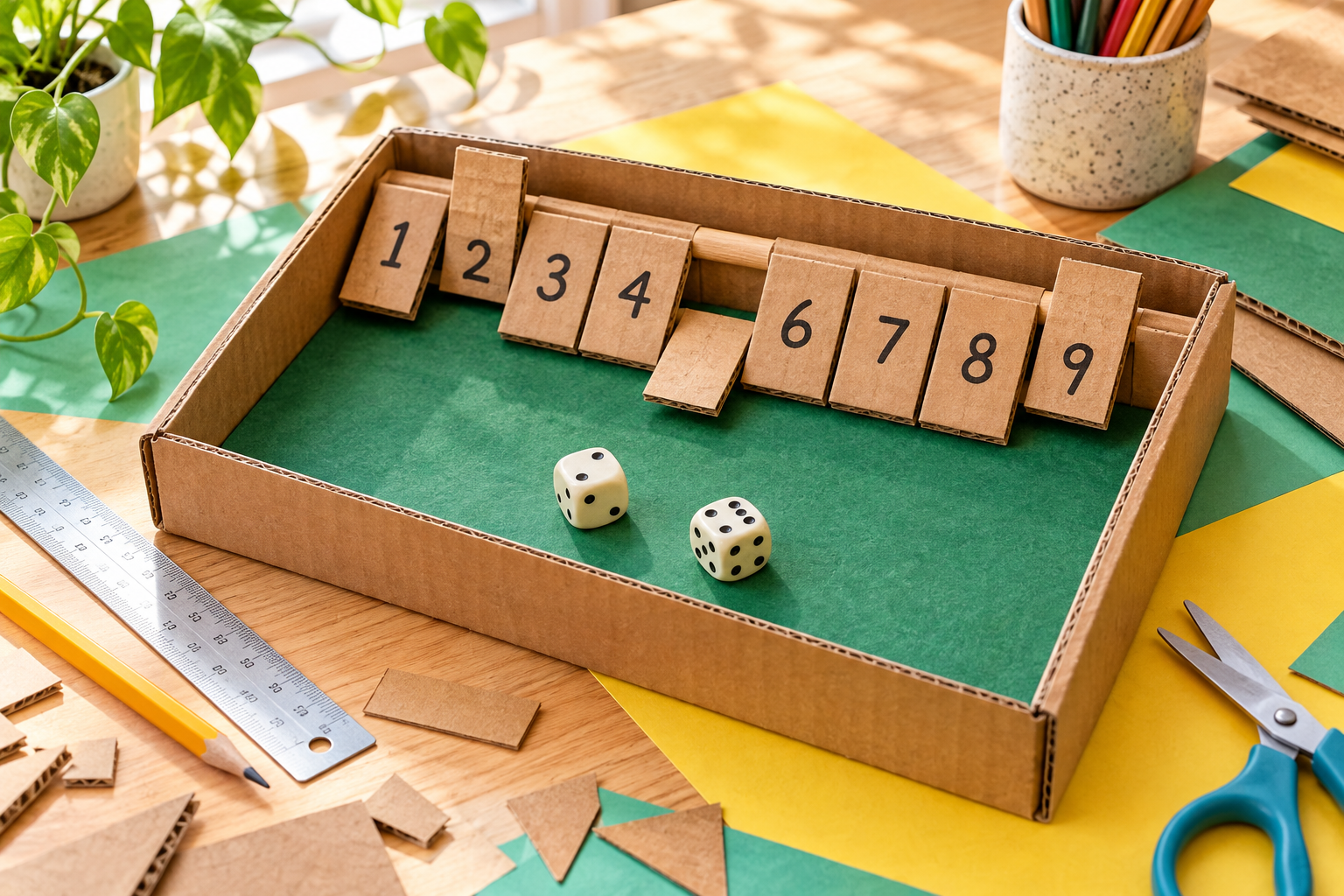
This guide describes a standard nine-tile version. A twelve-tile variant follows the same steps with a longer board and additional tiles. The cover image is a concept illustration, not a verified build record.
Gather the materials
A basic nine-tile Shut the Box set uses:
| Part | Suggested material | Quantity | |---|---|---| | Base board | Plywood or pine, 12 mm thick, approx. 300 x 200 mm | 1 | | Side walls | Pine strip, 10 x 20 mm | 2 | | End walls | Pine strip, 10 x 20 mm | 2 | | Numbered tiles | Hardwood offcut or craft wood, 40 x 50 mm | 9 | | Hinges | Small brass butt hinge, 25 mm | 9 | | Felt | Self-adhesive craft felt, enough to line the base | 1 sheet | | Dice | Standard 16 mm wooden dice | 2 | | Screws and glue | Wood screws (15 mm) and PVA wood glue | As needed |
Hardwood tiles last longer and look better, but plywood works for a first build. The hinge size matters: a 25 mm butt hinge fits a 40 mm tile without overhang.
Cut the base and walls
Cut the base to 300 x 200 mm. This gives enough interior length for tiles 1 through 9 in a single row, plus room for two dice to roll without hitting the tiles.
Attach the four walls around the base edges with PVA glue and small screws. The walls keep the dice inside the board. Interior height should be about 20 mm above the base — enough to contain a rolling die without blocking the tiles.
Make the numbered tiles
Cut nine tiles from a hardwood strip. Each tile is 40 x 50 mm. Number them 1 through 9 with a permanent marker, wood-burning tool, or painted stencil.
The tile thickness should match the wall height so that a closed tile lies flat against the board. If your walls are 20 mm tall, cut tiles to about 10 mm thick. This leaves clearance for the hinge knuckle.
Install the hinges
Attach one hinge to the bottom edge of each tile. Screw the other leaf to the back wall of the board, spacing the tiles evenly across the width.
| Tile | Spacing from left edge | |---|---| | 1 | 15 mm | | 2 | 60 mm | | 3 | 105 mm | | 4 | 150 mm | | 5 | 195 mm | | 6 | 240 mm | | 7 | 285 mm (adjust if walls differ) |
The exact spacing depends on your tile width and wall thickness. Lay the tiles out dry before drilling any holes. A tile that overlaps its neighbour will bind when it flips.
Add the felt surface
Peel and stick the felt to the base interior after all hinges are installed. Felt quiets the dice and reduces bounce, which matters when a roll must stay inside the tile row. Trim the felt so it does not climb the walls.
Test the mechanism
Flip each tile up and down. A properly installed tile stands upright on its own and falls flat when tapped. If a tile slides or sticks, check the hinge alignment before gluing anything permanently.
Roll the dice several times. If a die regularly escapes over a wall, add a taller wall or a lip at the front edge.
Play the game
The rules are simple: roll two dice, close one or more tiles whose values sum to the roll, and continue until no legal combination remains. Your score is the sum of the open tiles. Close every tile to score zero.
For the complete rule set, see the Shut the Box rules. For strategy once the board is built, read the strategy guide. The scoring guide explains how to record match totals.
A note on the illustration
The cover image is an AI-generated concept illustration. It shows tools and materials in a workshop setting, but it does not depict a specific verified build. Measurements in this guide are starting points; adjust them to your materials and tools.
Rules scope: The Little Dice Club rules. Sources and calculation methods. Probability examples are not overall game win rates.