The dice notebook
Shut the Box Scoring: Examples, Ties and Match Totals
In the sum-based version used here, your Shut the Box score is the total of the tiles left open when your round ends. Lower is better. Close every tile and you score zero.
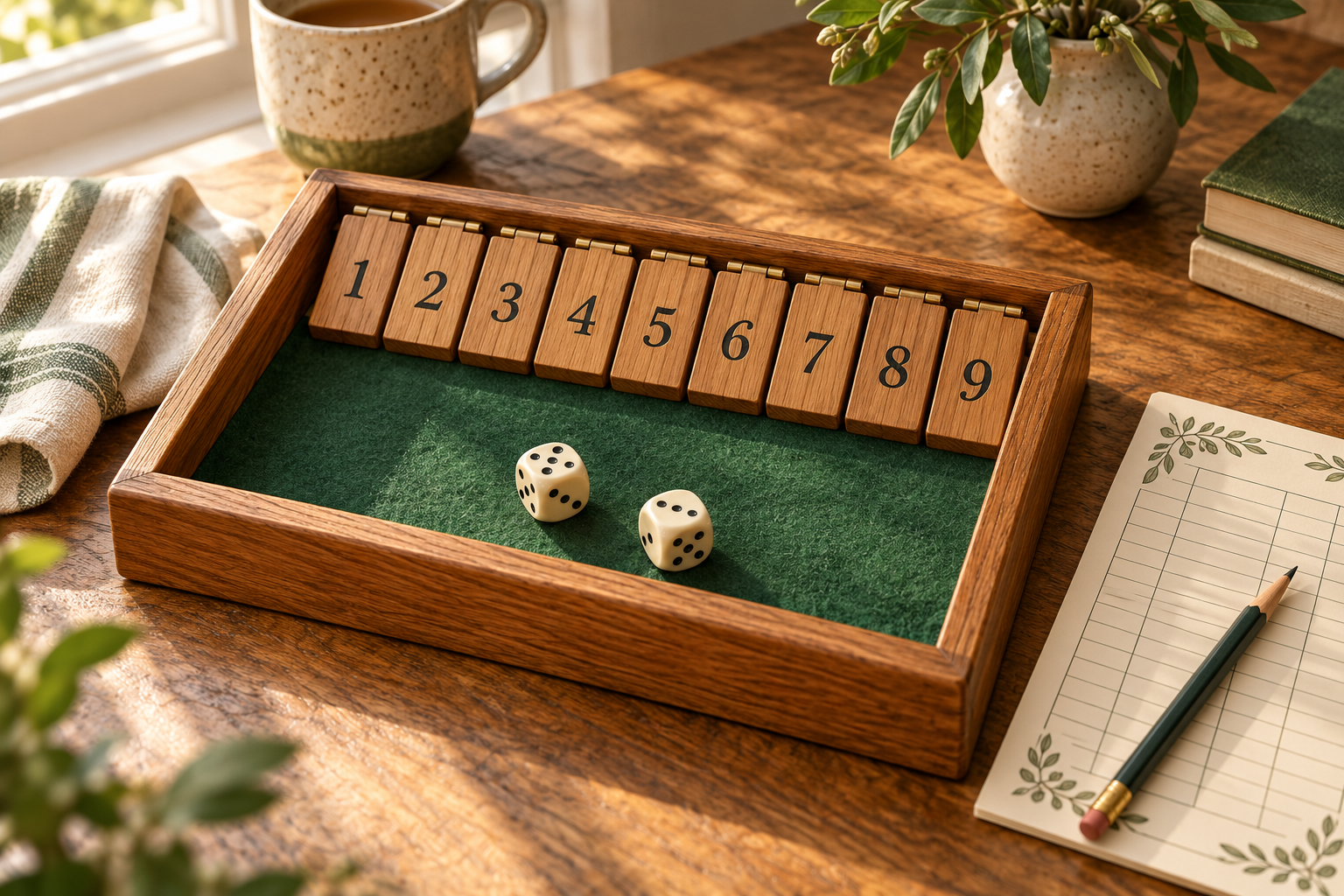
Add only the tiles that remain open
If 2, 3 and 8 are still open, the score is 13. If only 9 is open, the score is 9. The second position has a lower score even though its remaining tile is larger than either 2 or 3. Count the values, not the pieces.
Do not add the dice that ended your round. A roll can be impossible to match without changing any tiles. For example, with only 4 open, a one-die roll of 2 ends the round at 4 points. It does not produce a score of 6.
Know when the score becomes final
During play, the open sum is a running total that can fall as you close tiles. On a nine-tile board it begins at 45; on a twelve-tile board it begins at 78. Those values come from adding 1 through 9 or 1 through 12, not from different scoring multipliers.
Your round becomes final when no legal combination matches the roll, or every tile is closed. A player cannot reopen a tile to reduce the score later. Our full rules explain how to identify a legal move before deciding that a round has ended.
Compare examples before playing a match
| Open tiles at the end | Calculation | Score |
|---|---|---|
| None | No values left | 0 |
| 1, 4 | 1 + 4 | 5 |
| 2, 3, 8 | 2 + 3 + 8 | 13 |
| 9 | 9 | 9 |
These examples also show why “fewer open tiles” is not a scoring rule. Three small tiles can total less than one large tile. The only reliable check is to write out the addition.
Handle ties explicitly
For a single online friend round, equal lowest scores tie. A player who reaches zero does not take away the next player’s opportunity to finish. The room lists each completed score so everyone can compare the same result.
For a physical match, agree on whether ties stand or require another round before starting. Roll count is not a default tie-break on this site. If one player needs fewer throws to score the same total, that alone does not make them the winner.
Keep cumulative totals separate
Suppose A scores 12, 7 and 15 across three rounds, while B scores 9, 11 and 10. Their cumulative totals are 34 and 30, so B wins that agreed three-round match. Winning more individual rounds is not a separate scoring bonus.
Use the printable score sheet to keep one column per player. Online friend rooms currently compare rounds individually; they do not retain an automatic running match total. Practice bests also track the lowest single score rather than the sum of your sessions.
Check whether a different scoring variant is in use
The general variants reference describes alternatives, including counting open tiles and reading remaining digits as a number. Those methods produce different results. The tiles 1, 2 and 5 total 8 under our rule; a digit-reading variant could call the result 125.
Use one method consistently. If you want to experiment, label the session as a different house-rule game and start a fresh score sheet.
Rules scope: The Little Dice Club rules. Sources and calculation methods. Probability examples are not overall game win rates.