The dice notebook
Shut the Box House Rules: Agree Before the First Roll
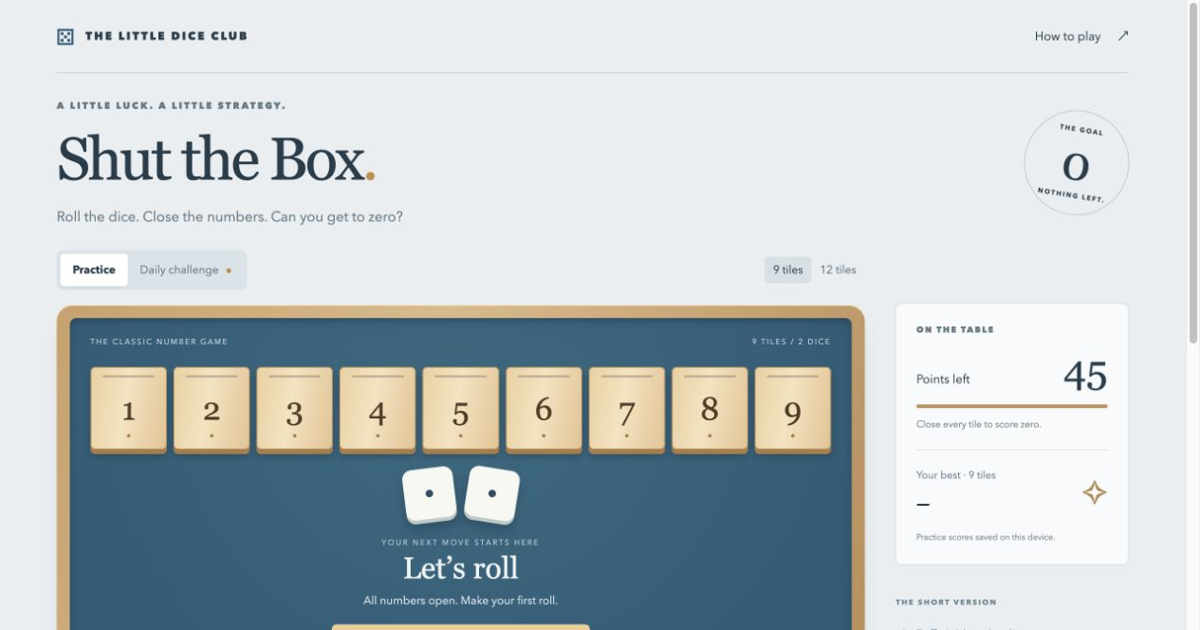
Before a Shut the Box session, agree on board size, permitted dice, legal tile moves, scoring and ties. Different house rules can change both the result and the strategy, even when the board looks identical.
Start with a short agreement
A useful agreement describes decisions players will actually face. For example: “Nine tiles; use two dice while a tile above 6 is open; otherwise one; close distinct open tiles equal to the dice sum; add remaining tiles; equal low scores tie.”
That is the core of the rules used here. It is short enough to read before playing and specific enough to settle a disagreement. “Use the normal rules” is less helpful when players learned the game from different sets.
Clarify dice choices
A compulsory switch and an optional switch are different rules. The Wikipedia overview describes an option to use one die once 7, 8 and 9 are unavailable. This website automatically uses one when every remaining tile is 6 or lower, including on its twelve-tile board.
If a group uses the remaining sum rather than the highest open tile as its trigger, write that separately. With 5 and 6 open, the total is 11 but neither tile is above 6. That position exposes the difference immediately.
Define the arithmetic allowed
Here, add the dice and close a combination matching that total. You cannot subtract faces, multiply them, split a tile or reuse a closed tile. A dice roll of 2 and 5 produces target 7, not a choice between 3, 7 and 10.
Other variants may permit different arithmetic. If your instruction sheet does, follow that set consistently rather than changing the operation after a difficult roll. The website does not offer a subtraction-mode setting. Doubles also have no special bonus here.
Pick one scoring method
The published variants overview lists sum-based scoring, counting open tiles and reading remaining digits as a number. For open 1, 2 and 5, those approaches would give 8, 3 and 125 respectively. They are separate scoring systems, not three ways to calculate the same score.
Our game uses the sum, and its score sheet is labelled for that method. If you use another scoring system on paper, label it prominently and do not mix its results into a sum-based session.
Agree on endings and ties
Decide whether someone reaching zero ends a physical game immediately or whether everyone finishes their scheduled turn. In our online rooms, everyone gets their turn and equal zeroes tie. This keeps each round’s comparison explicit.
Also decide whether a longer match uses cumulative scores or the number of round wins. Those measures can select different winners. Online next-round play currently starts a new score comparison and does not calculate an overall tournament total.
Keep variants in separate records
Write the board size and house rules at the top of a fresh record. Do not compare a twelve-tile digit-scoring result with a nine-tile sum-scoring best. Similar-looking numbers do not guarantee equivalent difficulty or scoring.
If you want to play under this site’s fixed rules, open the board or create a friend room. If you want to invent a physical-table variant, keep its instructions next to the dice so the change is transparent to everyone before the first roll.
Rules scope: The Little Dice Club rules. Sources and calculation methods. Probability examples are not overall game win rates.