The dice notebook
A Shut the Box Addition Activity for the Classroom
Use Shut the Box as an addition activity by asking learners to explain a legal tile combination before closing it. A short session can focus on making one total in different ways, with a written record of the choices.
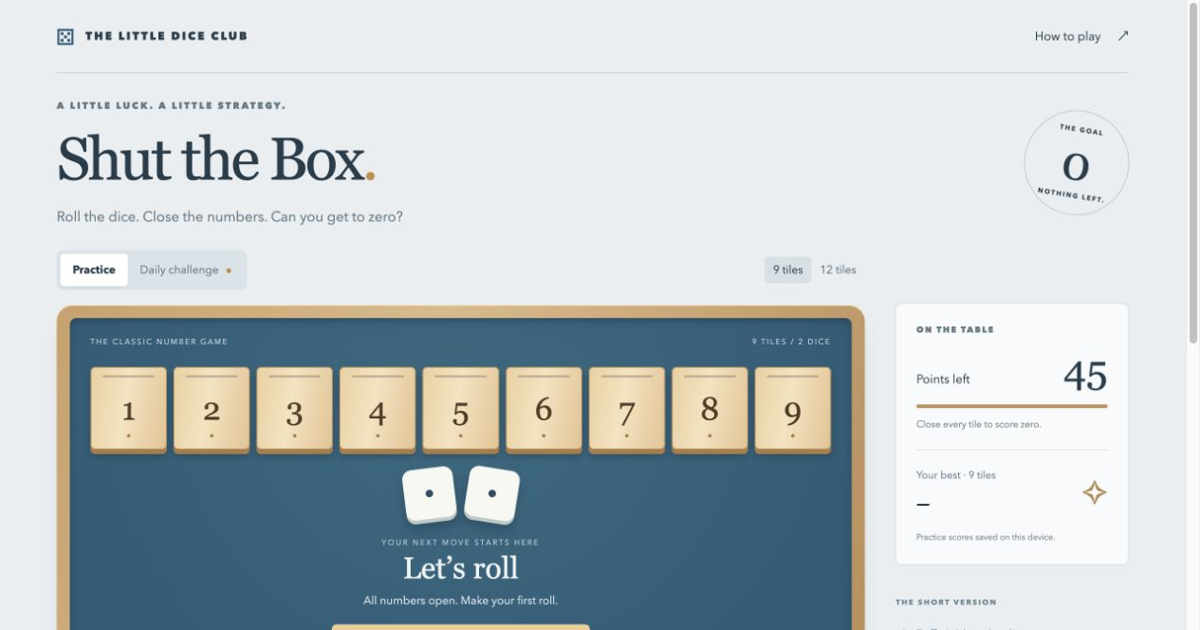
Choose a clear learning task
For one lesson, focus on addition and number combinations. Ask learners to say the dice total, identify available tiles and check their sum aloud. Keep the game rules visible so difficulty comes from the arithmetic rather than remembering a changing instruction.
A nine-tile board is enough for this activity. A physical board can be shared, or draw boxes numbered 1 through 9 on paper and cross them out. Paper is an activity adaptation, not a feature of the online game. Reset the marks before starting another round.
Model one worked move
Suppose the dice total is 8 and all tiles are available. Show that 8, 1+7, 2+6 and 3+5 are different valid choices. Then ask whether three tiles can also work. The combination 1+2+5 is valid because it uses distinct open numbers and totals 8.
Explain why 4+4 is unavailable on a board with one tile 4. A correct arithmetic statement is not always a legal board move. Learners need to check the resources on the board as well as the numerical equality.
Use a repeatable partner routine
Give one learner the role of player and another the role of checker. The player proposes a combination; the checker verifies that every selected tile is open, no tile is repeated and the total matches. Then swap roles for the next complete round.
Ask the checker to explain disagreements with the actual addition. Avoid letting “that looks wrong” settle a decision. The routine makes the reasoning visible and gives both learners something to do while only one board is active.
Record the decision, not just the score
| Roll total | Chosen tiles | Addition check | Another legal choice |
|---|---|---|---|
| 8 | 1, 2, 5 | 1 + 2 + 5 = 8 | 3 + 5, if open |
| 7 | 3, 4 | 3 + 4 = 7 | 2 + 5, if open |
A round score is influenced by dice as well as decisions. It should not be treated as a direct assessment of arithmetic ability. A written explanation gives a more specific record of whether the learner identified and checked a combination.
Adjust support without hiding the rule
For learners who need support, display a number line or allow counters while they verify the sum. Pause before closing tiles so there is time to explain. For a further challenge, ask for all possible combinations for a small total and a reason the list is complete.
The roll-of-seven reference supplies a checkable example. If you change the game to permit only two tiles or to use different dice, label it as a classroom adaptation rather than the exact rules of the online board.
End with a short discussion
Ask why a combination that worked early might be unavailable later. Invite learners to distinguish the dice total from the final sum of open tiles. These questions target the reasoning used during the activity without requiring a competitive winner.
For another session, keep the same recording routine and change the example totals. If you want a competition, use the separate printable score sheet, but keep performance feedback tied to the learner’s explanations rather than a lucky low score.
Rules scope: The Little Dice Club rules. Sources and calculation methods. Probability examples are not overall game win rates.