The dice notebook
How the Shut the Box Daily Challenge Uses the Same Dice
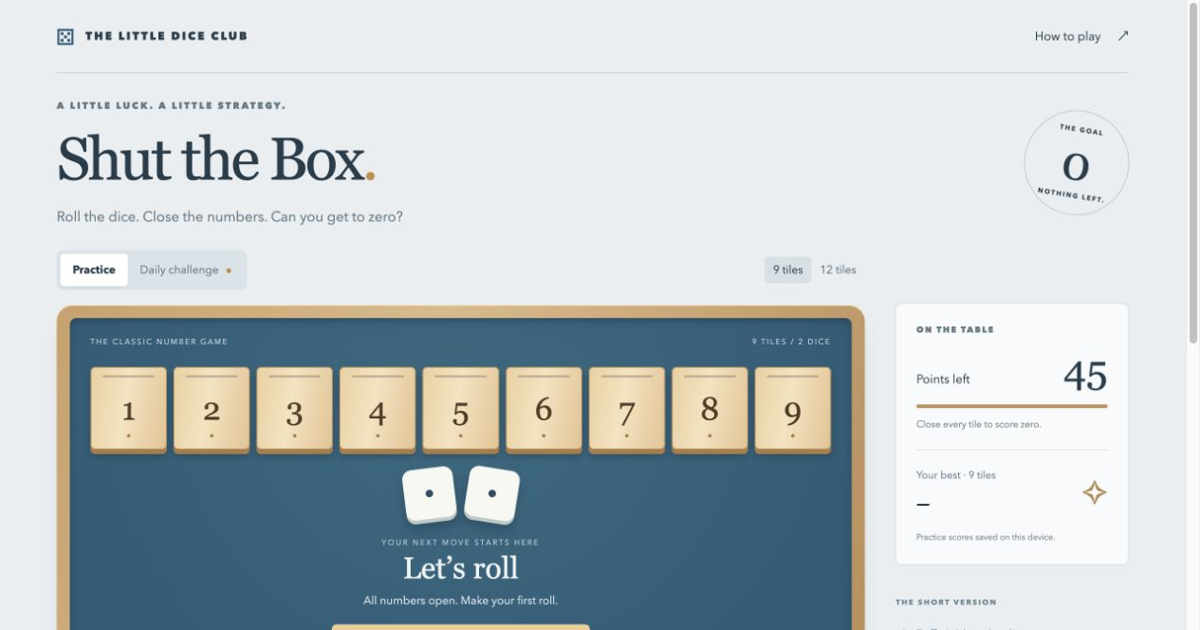
Our Shut the Box daily challenge uses a nine-tile board and the same ordered sequence of dice pairs for each UTC date. Your tile choices still matter, and the one-die stage can make two players display different totals.
Begin with a shared sequence
Practice mode generates fresh dice for a new roll. Daily mode instead loads that day’s sequence from the server. Two people playing the same UTC date begin with the same board and receive the same first pair.
Both players then choose which tiles to close. Matching dice do not force matching decisions. A roll of 8, for instance, may allow 8 or 3+5 while those tiles are open. Different choices leave different boards for the next pair.
Understand why displayed totals can diverge
Imagine an upcoming pair is 2 and 5. A player with tile 8 still open uses both dice and must make 7. A player whose open tiles are all 6 or lower uses only the first die and must make 2. Both consumed the same pair at that roll index.
This is the website’s automatic one-die rule, not an error in the shared sequence. Comparing only the displayed total without checking the board can make a fair daily challenge look inconsistent.
Check the date before comparing results
The server selects a challenge by UTC date. Local midnight can occur before or after midnight UTC. Ask your friend which challenge date appears above the board instead of assuming that “today” refers to the same puzzle for both of you.
If a new UTC day starts while your round is open, the game asks you to load the new challenge before continuing to roll. This avoids silently mixing two dates within one result. Your device’s local calendar is not the challenge identifier.
Replay to compare decisions
After finishing, you can replay the same date. Try another combination at an early decision and watch how the remaining board develops. Because the base sequence stays fixed, a replay can help isolate the effect of your choices better than a fresh practice round.
It is still not an optimal-strategy proof. A different choice may work better for this particular sequence without having a better expected result across all possible future rolls. The strategy overview explains that distinction.
Share a result with enough context
The daily result includes its date, remaining points, roll count and a small tile grid. Lower scores are better. Roll count is extra context, not a tie-break rule. A friend should compare the same challenge date and understand that replays are permitted.
There is no verified ranking, cash prize or claim that a copied result is tamper-proof. These are friendly comparisons. If you want to play together and watch a live shared board, choose a friend room; those rooms give each player independent dice instead of the daily sequence.
Choose daily or practice for the task
Use daily for a repeatable puzzle you can discuss. Use practice for fresh rolls, twelve-tile play and local best-score tracking. Daily mode stays at nine tiles and does not replace your practice best.
You can open the game, select Daily challenge, and read the displayed date before making your first roll. No account is needed for either single-player mode.
Rules scope: The Little Dice Club rules. Sources and calculation methods. Probability examples are not overall game win rates.