The dice notebook
What Can You Close on a Roll of 7 in Shut the Box?
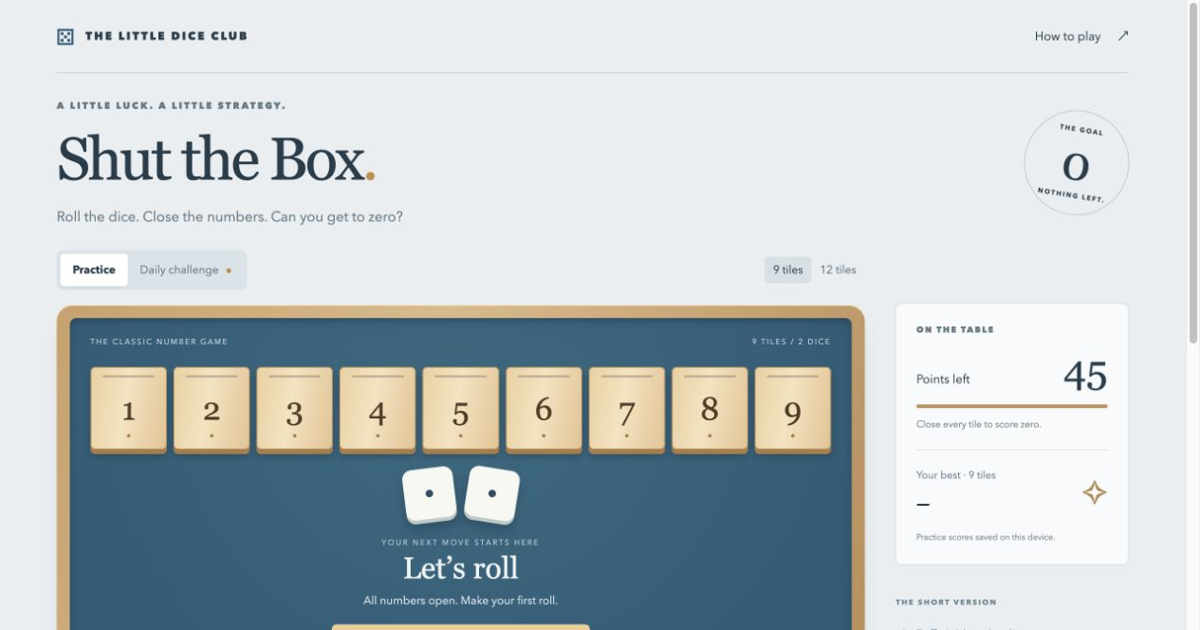
With tiles 1–9 all open, a roll of 7 has five legal combinations: 7, 1+6, 2+5, 3+4 and 1+2+4. Once some tiles are closed, remove every combination that uses one of them.
Start with the complete list
| Tiles to close | Tile count | Total |
|---|---|---|
| 7 | 1 | 7 |
| 1 + 6 | 2 | 7 |
| 2 + 5 | 2 | 7 |
| 3 + 4 | 2 | 7 |
| 1 + 2 + 4 | 3 | 7 |
The list is also complete on a twelve-tile board. Tiles 8 through 12 cannot participate because they already exceed 7, and all tile values are positive. Four distinct positive tiles cannot make 7 either: the smallest possible set, 1+2+3+4, totals 10.
Remove combinations that use closed tiles
Suppose 1, 2, 4, 5 and 8 are open. Of the five combinations, only 2+5 and 1+2+4 remain legal. Tile 7 is closed, tile 6 is closed, and tile 3 is closed, removing the other options.
If only 2, 4 and 8 are open, there is no legal combination for 7. You cannot substitute a closed 1 or split tile 8 into smaller numbers. Under the standard rules used here, that roll ends the round and scores the open sum of 14.
Do not use the same tile twice
The expression 1+1+5 totals 7, but it is not a legal move on a board with a single tile 1. Similarly, 2+2+3 requires a second tile 2 that does not exist. The list is a set of distinct available tiles, not every possible arithmetic expression.
You may close three tiles when they are distinct and add up correctly. There is no two-tile limit on this site. The dice display also does not force you to match its individual faces: a roll of 2 and 5 can still close 3+4.
Compare the boards left behind
Closing tile 7 removes a high value while preserving the smaller tiles. Closing 1+2+4 removes three smaller tiles. Both actions reduce the running score by exactly 7, so their immediate scoring effect is identical.
The difference is in future options and possibly the one-die switch. You need the rest of the board and a clearly defined goal to rank them accurately. Counting closed tiles or always choosing the largest tile is not an exact solver.
Use the list to check your reasoning
In practice mode, roll first and choose tiles whose total matches. The “Show a combination” control can reveal legal choices you missed; it cycles through combinations without ranking their quality. It is not labelled an optimal-move engine.
Try a small exercise on paper: cross out 1 and 7 from the fully open board, then find the remaining ways to make 7. You should keep 2+5 and 3+4. After checking, use the strategy overview to think about what each move leaves available for later rolls.
Rules scope: The Little Dice Club rules. Sources and calculation methods. Probability examples are not overall game win rates.