The dice notebook
Shut the Box Strategy: How to Choose Better Moves
Shut the Box strategy is about the board you leave behind, not only the tiles you close now. When two legal combinations match the roll, compare the open tiles, the combinations they can make later, and whether the game is about a low score or closing every tile.
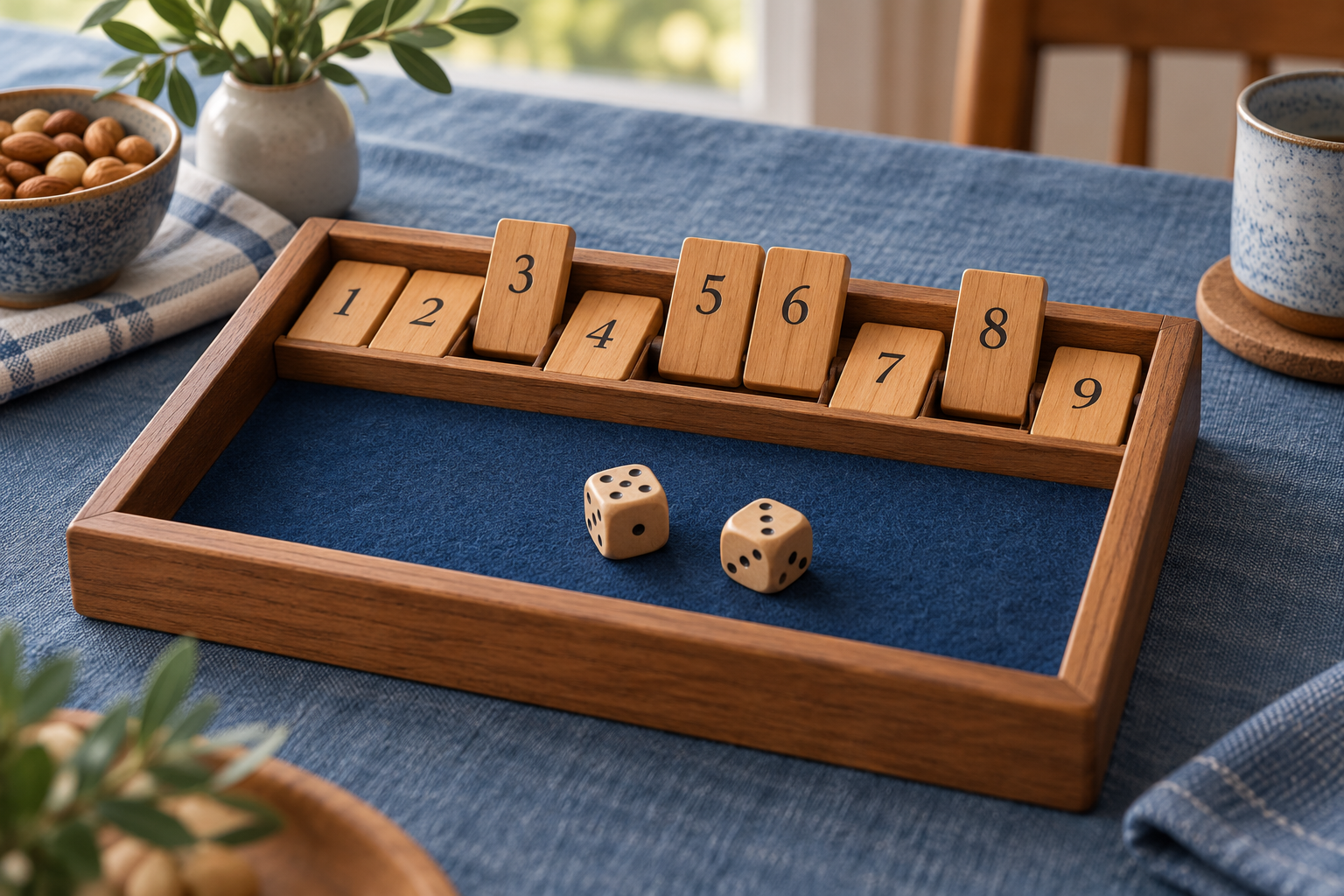
Compare the position after each legal move
Suppose 1, 3, 5 and 8 are open and the roll is 8. You can close 8, or close 3 and 5. Both choices remove eight points, but they leave different boards:
| Move | Tiles left | What changes | |---|---|---| | Close 8 | 1, 3, 5 | Several small tiles remain available individually. | | Close 3 and 5 | 1, 8 | A later two-dice total may be needed to close 8. |
There is no universal rule that always selects one option. Compare the next legal combinations and your actual goal.
Protect useful combinations
Small tiles can work together. If 1 and 6 remain, they can cover a roll of 7. If you close one of them, that future combination disappears. This does not mean you should always keep small tiles: a high tile can also create an awkward late position.
The useful question is: “What rolls can this board answer after my move?” Count the legal combinations rather than following a slogan such as “always close the highest tile.”
Plan for the one-die switch
On the standard rule set used here, once every open tile is 6 or lower, the next roll uses one die. That removes totals from 7 through 12. Before making a move that leaves only small tiles, check whether the remaining board still has several one-die answers.
The switch is not automatically bad. It can make a compact board easier to finish. But it changes the probabilities and the combinations available. The one-die guide explains the transition with examples.
Choose a goal before choosing a rule
Two common goals are a low final score and shutting every tile. They overlap, but they are not identical. A move that leaves a slightly higher short-term total may preserve combinations that improve the chance of reaching zero. A move that closes a high tile may be better when your goal is simply to reduce the final sum.
Write down the goal before the roll. Then compare moves against that goal instead of changing the standard halfway through the game.
Practice with a real board
Open the online Shut the Box game, roll, and list every legal combination before clicking a tile. After each move, say which future totals the remaining board can answer. For a rules refresher, use the Shut the Box rules. For a written score record, use the scoring guide.
No strategy guarantees a win. Dice still decide which positions you must face. A good habit simply makes the choice visible: list the legal moves, compare the boards they leave, and keep the rule set and goal consistent.
Rules scope: The Little Dice Club rules. Sources and calculation methods. Probability examples are not overall game win rates.