The dice notebook
Pig Dice Game Rules: How to Play, Score and Win
Pig is a dice game in which you choose between rolling for more points and holding to save the points you have earned this turn. Roll 2–6 and add that number to your turn total. Roll 1 and lose the unbanked turn total. Hold to add it to your saved score and pass the die. In the single-die version on this site, the first player to bank at least 100 points wins.
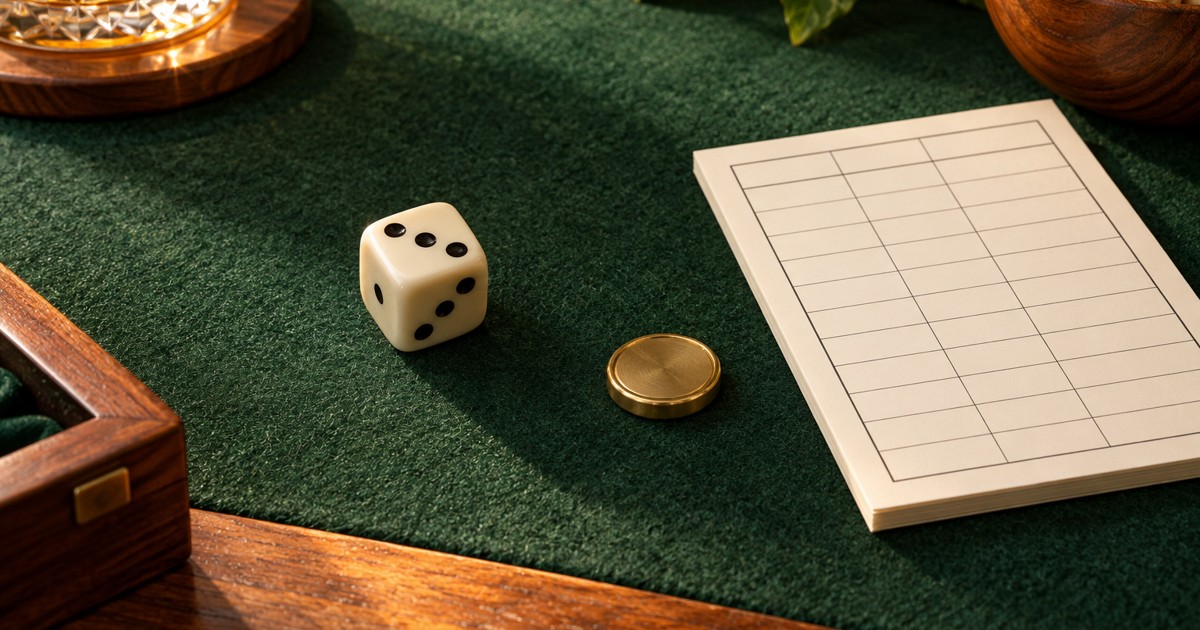
You can play Pig online against the computer or invite friends to join from their own devices. This guide covers that version, with a scoring example you can also use at a table.
Set up a game of Pig
For a physical game, use one ordinary six-sided die and paper to track each player’s banked score. Start everyone at zero, choose who goes first, and agree on a target of 100. Keep the current turn total separate from the saved score; keeping those two numbers separate avoids confusion.
For online play, open More games on ShutTheBox. Choose Play computer for a game on your own, or Friend room for two to four people. Each friend uses their own phone or computer. There is no need to pass around a phone.
What happens on each roll?
| Action or result | Turn total | Banked score | Who plays next? |
|---|---|---|---|
| Roll 2, 3, 4, 5 or 6 | Add the number rolled | Unchanged | You choose Roll or Hold |
| Roll 1 | Reset to zero | Unchanged | The next player |
| Hold | Bank it, then reset it | Add the turn total | The next player, unless you have won |
After any successful roll, you may roll again or hold. There is no fixed number of rolls in a turn. Each extra roll puts the entire current turn total at risk, including points from earlier rolls in that same turn.
On this site, you need to roll before holding: Hold is unavailable when you have no turn points. A 1 ends the turn automatically, so you cannot choose to hold after seeing it.
A complete scoring example
Suppose your banked score is 35. You roll a 4, then a 6, then a 3. Your turn total is now 13, while your banked score is still 35.
- If you Hold now, you bank 13. Your score becomes 48 and the next player takes a turn.
- If you roll again and get a 5, your turn total becomes 18. You can then Hold for a banked score of 53 or roll again.
- If you roll again and get a 1, your turn total becomes zero. Your banked score stays 35 and your turn ends.
The 1 does not subtract 13 from your saved 35. Those 13 points had never entered your banked score. Keeping two separate columns on a paper score sheet makes this easy to follow.
How to win: bank 100 or more
You do not need to land on exactly 100 in this version. If you have 92 banked points and collect 11 turn points, Hold takes you to 103 and wins the game.
Reaching that combined total while rolling does not finish the game here. You must bank it. Continuing to roll with a winning turn total still risks a 1, which would leave you at your previous banked score. Once you have enough, Hold.
If you play with a physical set or a different app, agree on the winning rule first. This guide describes the single-die, bank-at-least-100 game available on ShutTheBox; it does not describe every Pig variant.
When should a beginner hold?
Start with a simple target you can remember, such as holding when your turn reaches 20 points, and always hold when you have enough to win. Our computer opponent uses those two conditions. It is a transparent beginner opponent, not a claim of optimal play.
With a fair six-sided die, the chance of a 1 on the next roll is always 1 in 6. A run of safe rolls does not make the next roll safer or make a 1 “due.” What changes is the amount you would lose: rolling again with 3 turn points risks 3; rolling again with 23 risks 23.
A fixed hold target is easy to use, but it ignores the opponent’s score. A player facing an opponent near 100 may choose more risk than someone with a large lead. If you want a deeper mathematical treatment, Todd Neller and Clifton Presser’s Optimal Play of the Dice Game Pig examines strategy. Check its assumptions before applying a strategy to another variant.
Play online against the computer or friends
Open Pig in More games. In computer mode, use Roll to build a turn total and Hold to bank it. The computer opponent runs in your browser; you do not need another person or a second device for that mode.
For a friend game, open the friend-room option and create a room. Share its invitation with your friends so each person can join on their own device. Everyone selects Ready to play, then the host selects Start game. The room shows the shared game state and whose turn it is.
Games open in focus mode to keep the board and controls prominent. Use Exit focus if you want to see the surrounding page content. For a first game, watch both the turn total and banked score after every Roll or Hold; the example above explains why they change at different times.
How Pig differs from Shut the Box
Pig asks you when to stop rolling and bank points. Shut the Box asks you which open numbered tiles to close after a roll. In Pig, a higher banked score brings you closer to 100. In the sum-scoring Shut the Box game on this site, a lower final score is better.
If you are switching between the games, read the Shut the Box scoring guide before carrying over scoring assumptions. Pig has no numbered tiles to close and no one-die/two-dice switch during the game described here.
Frequently asked questions
Do you lose all your points when you roll a 1?
No. In this version you lose only the unbanked points from the current turn. Points saved with Hold on earlier turns remain in your score.
Do you need exactly 100 to win Pig?
No. Banking 100 or more wins on this site. You must press Hold to bank the winning turn total.
Can you play Pig by yourself?
You can play against the computer on this site. The computer takes the other turns. Friend rooms instead support two to four people on separate devices.
Does Pig use one die or two dice?
This guide and our online game use one six-sided die. Two-dice variants have different rules; do not apply their special outcomes to this game.
Ready to try the scoring example? Start a game of Pig, build a turn total, and use Hold to see it move into your saved score.
Rules scope: The Little Dice Club rules. Sources and calculation methods. Probability examples are not overall game win rates.