The dice notebook
Shut the Box with 1, 2 and 3 Left: Compare Your Moves
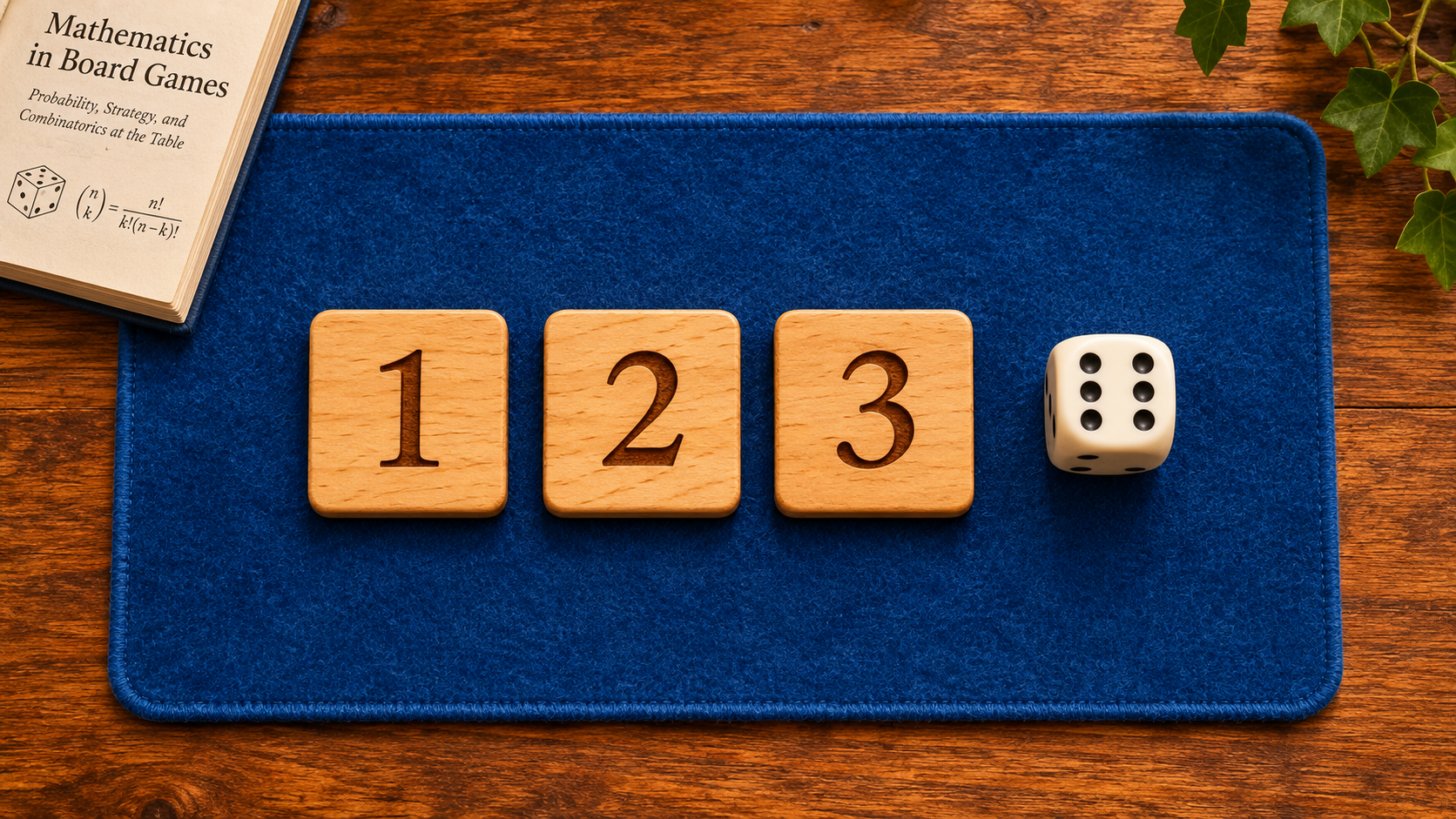
With only 1, 2 and 3 open, a one-die roll always has a legal move: the available subset sums cover 1 through 6. That does not guarantee clearing the board. On a roll of 3, closing tile 3 and closing tiles 1 plus 2 lead to different chances on the next roll.
Fix the rules first
This worked example assumes one fair six-sided die, addition-only moves, permanently closed tiles within the round, and a turn ending when no legal move remains. It follows the forced one-die stage described in the knowledge base for this site. A physical set with optional dice needs its own calculation. Read when to use one die before comparing variants.
The calculations below are exact enumerations of these small states. They are not measured player results or a whole-game win rate.
List the available moves
| Roll | Tiles you can close | | --- | --- | | 1 | 1 | | 2 | 2 | | 3 | 3, or 1 and 2 | | 4 | 1 and 3 | | 5 | 2 and 3 | | 6 | 1, 2 and 3 |
The sum of all open tiles is 6, so a roll of 6 clears the board immediately. A roll of 3 offers the only choice between different combinations.
Compare the two choices on a roll of 3
Closing tile 3 leaves 1 and 2. The next legal totals are 1, 2 and 3, giving a next-roll survival chance of 3/6. Rolling 3 clears both immediately; rolling 1 or 2 leaves one tile that must be rolled later.
Closing 1 and 2 leaves only 3. The next legal result is 3, giving a survival chance of 1/6. That successful roll also clears the board.
If your objective is to maximize the chance of clearing, keeping 1 and 2 is better in this particular state. Its eventual clear probability is `1/6 + (1/6 × 1/6) + (1/6 × 1/6) = 2/9`. Keeping only 3 gives `1/6`. These are probabilities after making the chosen move, not before the original roll of 3.
A different goal can change the decision
A low expected remaining score is a different objective from the highest probability of zero. For this same example, let the final score be the sum of open tiles when play ends.
With only tile 3 left, failure occurs on five faces, so its expected final score is `5/6 × 3 = 5/2`.
With tiles 1 and 2 left, rolls 4, 5 and 6 end with score 3. Rolling 1 leaves tile 2, whose expected score is `5/6 × 2 = 5/3`; rolling 2 leaves tile 1, whose expected score is `5/6`. Rolling 3 ends at zero. The expected score is therefore `3/6 × 3 + 1/6 × 5/3 + 1/6 × 5/6 = 23/12`, lower than `5/2`.
Both objectives favor keeping 1 and 2 here. This agreement is a result for this position, not proof of a universal rule to keep small tiles.
Use the example at the board
Before moving, state the remaining tiles and list the totals they can make. Then distinguish a playable next roll from an immediate clear and from an eventual clear. This routine makes a strategy comparison concrete.
The dice-probability guide applies the same distinction to other states. For another board size or a two-dice choice, recompute the outcomes rather than carrying these fractions across unchanged.
Rules scope: The Little Dice Club rules. Sources and calculation methods. Probability examples are not overall game win rates.