The dice notebook
Shut the Box 12 Strategy: Plan Around 10, 11, and 12
On a twelve-tile Shut the Box board, tiles 10, 11, and 12 have fewer possible closing totals than smaller tiles. Before choosing a combination, check which high tiles can still close, what other tiles they can combine with, and whether your move triggers the switch to one die.
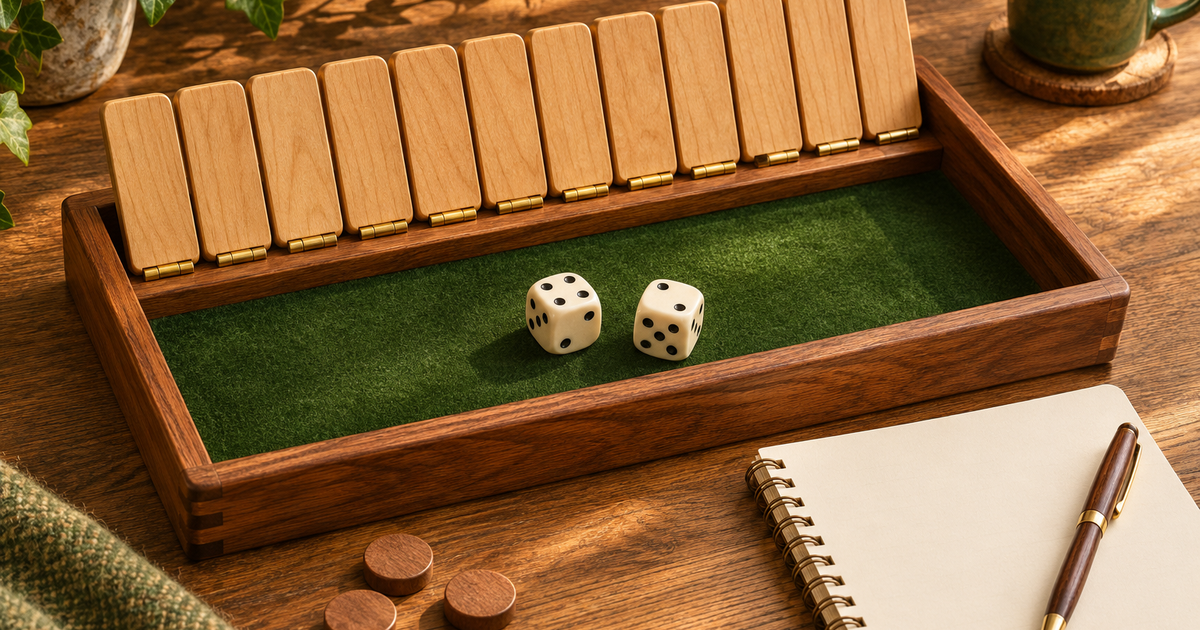
That is a position-reading method, not a universal rule to close the largest tile. The twelve-number guide covers setup and ordinary turns. Here the focus is comparing the high-tile choices that setup creates.
Keep the rule set fixed
Under the website's rules, selected open tiles must sum exactly to the current roll. Each numbered tile appears once. Closed tiles cannot be reused or reopened, and separate rolls never accumulate.
Two ordinary dice produce totals from 2 through 12. The website uses two dice while any open tile exceeds 6, then requires one die once every open tile is 6 or lower. A physical set may use another switch rule, so agree on that before borrowing a strategy.
The score is the sum of open tiles when no legal closure exists. Minimizing that score and maximizing the chance of closing everything are different objectives.
Map the high tiles to possible totals
These are every possible closure containing the named high tile, assuming the necessary small tiles remain open:
| High tile | Roll total | Closure containing it | |---|---:|---| | 10 | 10 | 10 | | 10 | 11 | 10+1 | | 10 | 12 | 10+2 | | 11 | 11 | 11 | | 11 | 12 | 11+1 | | 12 | 12 | 12 |
You cannot use 10+1+1 because the board has only one tile numbered 1. You cannot close 10 and 11 together: their sum exceeds the maximum dice total.
The table describes legal access to high tiles. It does not prove which closure produces the best expected final score.
Compare a roll of twelve
Suppose only 1, 2, 10, 11, and 12 remain open, and the dice total is 12. Exactly three closures are available: 12, 10+2, or 11+1.
Closing 12 leaves 1, 2, 10, and 11. Closing 10+2 leaves 1, 11, and 12. Closing 11+1 leaves 2, 10, and 12. Every choice removes twelve points, so every resulting open sum is twenty-four.
The immediate score reduction therefore cannot distinguish them. Their future legal totals differ, and the last two choices keep tile 12 dependent on another twelve. This is a concrete reason to compare resulting boards rather than assuming that equal removed sums mean equivalent decisions.
Separate roll odds from game odds
For fair independent dice, a particular roll totals 10 in three ordered outcomes, 11 in two, and 12 in one, out of 36 equally likely outcomes. Those probabilities are 3/36, 2/36, and 1/36.
They are probabilities of the next total, not of winning a complete game or eventually closing a particular tile. Legal survival on other rolls determines whether you receive another chance.
Watch the final high tile
If you close the last tile above 6, the next roll switches to one die here. With only 2 and 5 left, either individual tile can close, but their combined total of seven is no longer available.
For practice, pause before a high-tile closure and name the resulting open tiles, next dice count, and available totals. That makes the consequence visible without pretending a simple slogan solves the entire twelve-tile game.
Rules scope: The Little Dice Club rules. Sources and calculation methods. Probability examples are not overall game win rates.